

MassGen v0.0.4: Comprehensive Algorithm Enumeration#
This case study demonstrates MassGen’s ability to handle exhaustive knowledge compilation requests, showcasing how multiple agents with different levels of reasoning capacity can collaborate to create an encyclopedic resource on algorithmic approaches. This case study was run on version v0.0.4.
Command:#
massgen --config @examples/providers/openai/gpt5_nano "provide as many ways to computer the n-th fibonacci number as possible"
Prompt: provide as many ways to computer the n-th fibonacci number as possible
Agents:
Agent 1: gpt-5-nano-1
Agent 2: gpt-5-nano-2
Agent 3: gpt-5-nano-3 (Designated Representative Agent)
Watch the recorded demo:
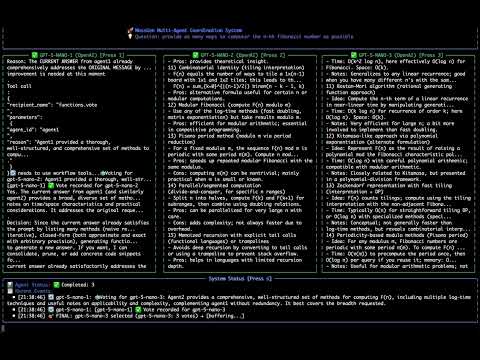
The Collaborative Process#
Comprehensive Coverage Strategy#
Each agent approached the exhaustive enumeration request by systematically covering different algorithmic categories:
Agent 1 (gpt-5-nano-1, minimal reasoning) provided foundational coverage:
Classical approaches: naive recursion, memoization, dynamic programming
Optimization techniques: space-optimized variants
Fast algorithms: matrix exponentiation, fast doubling
Mathematical approaches: closed-form solutions, generating functions
Practical considerations: big integer arithmetic, language-specific implementations
Agent 2 (gpt-5-nano-2, medium reasoning) offered structured categorization:
Organized by time/space complexity characteristics
Included modular arithmetic variants
Covered specialized techniques: Pisano periods, parallel computation
Provided practical implementation guidance and benchmarking suggestions
Agent 3 (gpt-5-nano-3, high reasoning) delivered advanced mathematical coverage:
Sophisticated algorithms: Kitamasa method, Bostan-Mori algorithm
Algebraic approaches: Lucas number relations, polynomial exponentiation
Combinatorial interpretations: Zeckendorf representation, tiling methods
Specialized contexts: modular arithmetic, precomputation strategies
Progressive Recognition of Superiority#
The voting process revealed a clear progression in comprehensiveness:
Initial Self-Assessment: Agent 2 initially voted for itself, recognizing its well-organized approach
Comparative Analysis: Agent 1 recognized Agent 3’s superior breadth, voting for the most comprehensive collection
Advanced Technique Recognition: Both Agent 2 and Agent 3 acknowledged Agent 3’s inclusion of advanced algorithms like Kitamasa and Bostan-Mori
The Unanimous Final Consensus#
All three agents converged on Agent 3’s answer, with unanimous recognition (3/3 votes) based on:
Breadth Criteria: Agent 3 included “advanced techniques (Kitamasa, Bostan–Mori, etc.) and modular variants, which better satisfies ‘as many ways as possible’”
Systematic Coverage: The answer provided “the most comprehensive and diverse set of Fibonacci computation methods, including classic and advanced approaches”
Practical Value: Integration of theoretical algorithms with implementation guidance and performance considerations
The Final Answer: Algorithmic Encyclopedia#
Agent 3 was selected to present the final answer, which featured:
Exhaustive Method Catalog (20 Distinct Approaches)#
Classical Methods: Naive recursion through optimized dynamic programming
Logarithmic-Time Algorithms: Matrix exponentiation, fast doubling variants
Mathematical Formulations: Binet’s formula, generating functions, combinatorial identities
Advanced Algorithms: Kitamasa method, Bostan-Mori algorithm, polynomial exponentiation
Specialized Variants: Modular arithmetic, Pisano periods, Lucas number relations
Optimization Strategies: Precomputation, parallel computation, space optimization
Implementation Guidance#
Time/Space Complexity Analysis: Clear O-notation for each method
Use Case Recommendations: When to choose each approach based on constraints
Practical Considerations: Handling large integers, precision issues, modular arithmetic
Language-Specific Notes: Implementation tips for different programming environments
Theoretical Depth with Practical Application#
The final answer successfully bridged theoretical computer science with practical programming, offering both mathematical insight and actionable implementation guidance.
Conclusion#
This case study demonstrates MassGen’s effectiveness in creating comprehensive reference materials through collaborative knowledge compilation. The system successfully:
Achieved Exhaustive Coverage - All agents contributed complementary knowledge areas, from basic algorithms to advanced mathematical techniques
Maintained Quality Through Competition - Each agent’s attempt to provide the most comprehensive answer drove the overall quality upward
Recognized Superior Synthesis - The voting mechanism correctly identified the most complete and well-organized compilation
Balanced Theory with Practice - The final answer provided both mathematical rigor and implementation practicality
This case showcases MassGen’s ability to extract maximum value from identical models through collaborative competition, making it particularly valuable for creating exhaustive reference materials, algorithm catalogs, and comprehensive technical documentation where breadth and completeness are paramount.